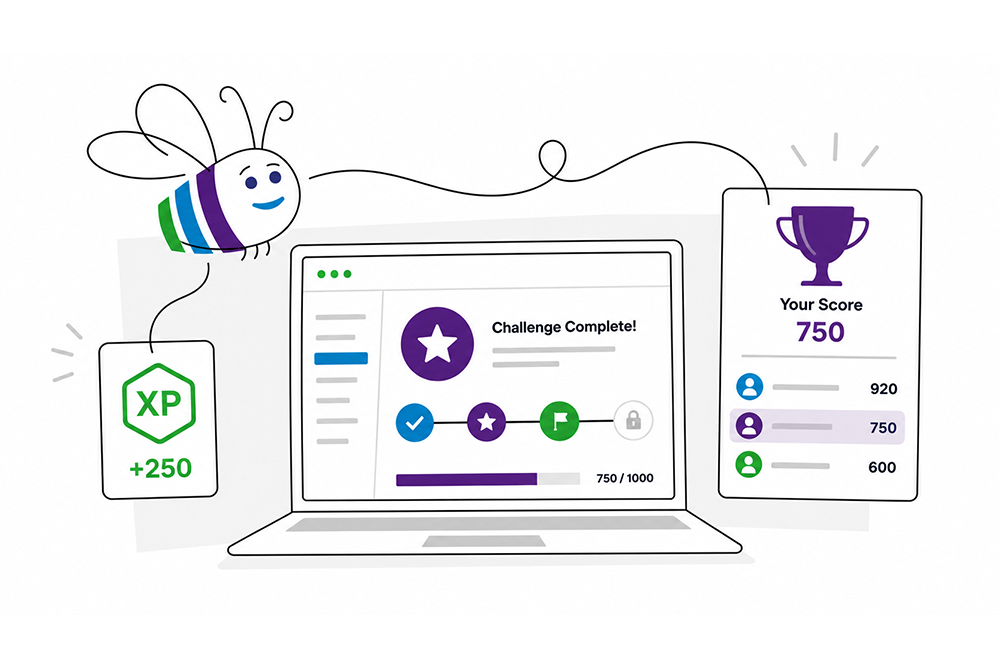
Gamification isn’t about games. It’s about engagement. Gamification in Articulate 360 is easier than ever. When people hear gamification, they often think points, badges, and leaderboards. But effective gamification is really about creating momentum, challenge, and interaction within the learning experience.
- A countdown timer before a critical decision.
- A branching scenario with consequences.
- A challenge that reflects real workplace pressure.
These small design choices can dramatically change how learners engage with content.
Across mining, healthcare, aviation, banking, and government, organisations are increasingly using scenario-based learning, progression mechanics, and interactive decision-making to transform procedural and compliance training into something more practical, engaging, and memorable.
In this article, we explore 10 easy ways to gamify your learning using Articulate 360 from simple scenario blocks in Articulate Rise 360 through to more advanced game mechanics in Articulate Storyline 360.
It Starts with Design – Not Tools
One of the biggest misconceptions about gamification is that it’s something you “add” at the end of a project. In reality, gamification starts with how the learning is designed.
Most traditional eLearning still follows a familiar pattern:
- present information
- explain the process
- test knowledge at the end
It often feels like reading a document on screen. Whether it’s:
- a mining safety induction
- a government compliance course
- airline onboarding
- a hospital procedure update
- or customer service training for a bank
…the experience can easily become passive. The learner clicks through information, completes a quiz, and moves on. But very little has changed in how they think or behave.
Gamification changes this by shifting the learner from reading to participating.
Instead of simply presenting information, you place learners into situations where they:
- make decisions
- solve problems
- respond to challenges
- experience consequences
That’s where engagement starts to increase.
10 Easy Ways to Gamify Your Course
The good news is you don’t need to build a complex game to create this type of experience. Here are practical ways to introduce gamification using Articulate 360.
1. Add a Character
Introduce a manager, colleague, customer, or team member to guide the experience. For example:
- a supervisor in a mining induction
- a nurse supporting a new starter in a hospital
- a customer interaction in a bank
- a passenger scenario for airline staff
Even simple illustrated characters can help transform procedural content into a more interactive experience.
The new AI Avatar features in Articulate Rise 360 now take this a step further by allowing presenter-style video segments directly inside a course, making learning feel more dynamic and immersive.
2. Turn Content into Decisions
Instead of explaining a process, ask “What would you do?”
This simple shift changes the learner from a passive reader into an active participant. For example:
- identifying a workplace hazard
- responding to a frustrated customer
- escalating a compliance issue
- making a safety decision under pressure
3. Use Scenario Blocks for Instant Interaction
The Scenario Block in Articulate Rise 360 is one of the easiest ways to introduce gamification. You can quickly create:
- multi-step conversations
- branching decisions
- immediate feedback
- realistic workplace situations
No advanced development required. This works particularly well for:
- onboarding
- customer service
- leadership
- compliance training
4. Make Feedback Meaningful
Replace: “Correct” and “Incorrect” with:
- “This could create a safety risk…”
- “This protects the customer and the organisation…”
- “Good decision under pressure.”
This makes feedback feel like consequence, not just assessment.
AI-generated feedback suggestions can also help instructional designers create more varied and realistic responses within scenarios, making interactions feel more dynamic and personalised.
5. Create Progression
Simple progression mechanics can dramatically improve engagement. Use:
- “Stage Complete”
- “Challenge Unlocked”
- “You’re Ready for the Next Shift”
These cues create momentum and give learners a sense of achievement.
6. Introduce Light Scoring
Gamification doesn’t always need full scoring systems. In Articulate Storyline 360, you can track learner decisions using variables and triggers.
In Rise, scoring can be simulated through:
- progression
- achievements
- feedback
- completion pathways
The key is helping learners feel like their actions matter.
7. Let Learners Choose Their Path
Branching scenarios create realism. For example:
- an airline crew member responding to an onboard issue
- a government employee managing sensitive information
- a water authority worker responding to contamination risk
Different choices can lead to different outcomes, reinforcing real-world decision-making.
8. Break the Course into Stages
Instead of presenting one long course, structure it as a journey. For example:
Stage 1: Foundations
Stage 2: Workplace Challenges
Stage 3: Final Assessment
This creates pacing and helps learners feel like they are progressing toward a goal.
9. Embed Challenges Throughout
Don’t leave interaction until the final quiz. Add:
- mini challenges
- quick decisions
- timed checkpoints
- scenario-based questions
In Articulate Rise, this can be achieved using combinations of scenario blocks, continue blocks, knowledge checks, labelled graphics and accordion interactions to keep learners actively engaged throughout the experience. This keeps learners engaged from beginning to end.
10. Allow Safe Failure
One of the most powerful aspects of gamification is allowing learners to:
- make mistakes
- see consequences
- try again safely
This is particularly valuable in healthcare, safety training, customer service and compliance learning
Learners build confidence through practice rather than simply reading procedures.
Built Easily in Articulate Rise
What’s important is that this no longer requires complex development. Using Articulate Rise 360, these experiences can be built using:
- Scenario Blocks
- Knowledge Checks
- Continue Blocks
- Text and media blocks
- Outcome screens
This makes gamification far more accessible for organisations wanting to improve engagement quickly.
From Simple to Advanced with Articulate Storyline
Once you’re comfortable designing learning this way in Rise, you can expand it further using Articulate Storyline 360.
This is where gamification can become more advanced through:
- dynamic scoring systems
- timers and countdowns
- layered branching
- personalised feedback
- interactive game mechanics
If you’d like to see what higher-level gamification looks like in practice, explore our Storyline example here Using Gamification in Articulate Storyline.
The Real Opportunity
Gamification hasn’t become more complicated. It’s become more accessible. The real difference now isn’t who can build it. It’s who can design learning experiences that feel engaging, practical, and relevant. You don’t need to build a game to gamify learning, you just need to:
- create decisions
- provide feedback
- build progression
- introduce challenge
And suddenly, your course becomes far more engaging than simply reading a document on screen.
Want to Learn How to Do This Properly?
Our workshops show you how to:
- design engaging learning experiences
- build gamified interactions using Articulate Storyline 360 and Articulate Rise 360
- apply practical techniques immediately in your own projects
Explore our Certified Articulate upcoming workshops and training schedule here.