Over the past decade, the learning and development landscape has changed dramatically. Today, learning content is everywhere.
Organisations can subscribe to vast libraries of ready-made courses covering everything from leadership and communication to cybersecurity, wellbeing and productivity. Content aggregators now offer thousands of modules that can be deployed instantly through a learning management system.
For learning teams, this has been an important shift. It allows organisations to expand their learning catalogues quickly and provide employees with access to a wide range of professional development opportunities.
Yet despite the rapid growth of content libraries, something interesting has happened. The demand for new eLearning content has not disappeared. Organisations across industries continue to invest in developing learning that reflects their own policies, systems and operational processes.
This is also reflected in the size of the eLearning development community. Platforms such as Articulate 360 – one of the most widely used authoring tools for digital learning – are used by millions of learning professionals worldwide to create their own training modules.
If so much learning content already exists, why are organisations still building their own?
A Different Way to Think About Learning Content
One way to understand this shift is to recognise that workplace learning actually serves two very different purposes.
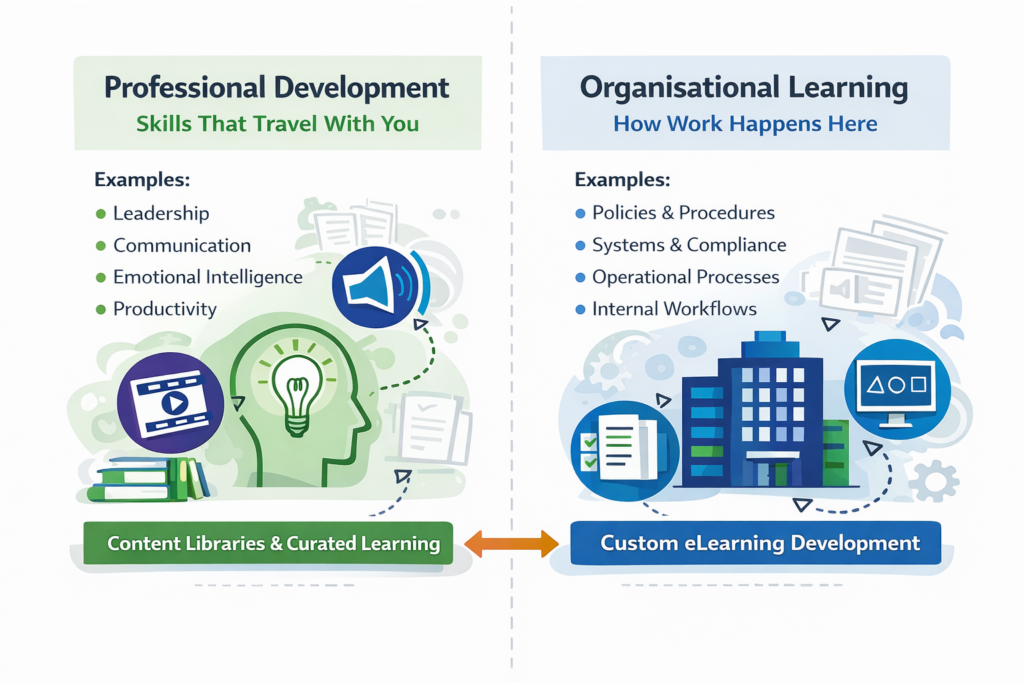
Some learning develops professional skills that individuals carry with them throughout their careers. These are capabilities such as leadership, communication, collaboration and personal productivity.
Other learning explains how work happens inside a particular organisation – the policies, systems, procedures and operational processes employees must understand to perform their roles effectively.
The first type of learning can often be sourced from content libraries. The second type is built from knowledge that exists only within the organisation itself.
Understanding this distinction helps explain why organisations continue developing learning content, even in a world where thousands of courses already exist.
Professional Development: Skills That Travel With You
Professional development focuses on capabilities that individuals build throughout their careers. These are transferable skills that remain valuable regardless of where someone works. They include areas such as leadership, communication, emotional intelligence, teamwork and time management.
Because these capabilities apply across industries and workplaces, they are well suited to content libraries.
A course on giving effective feedback, for example, can benefit employees whether they work in healthcare, banking, education or government.
In many organisations, content libraries provide a valuable way to support lifelong professional learning. Employees can explore new topics, build capabilities and continue developing their skills over time.
For this type of learning, the library model works well. But professional development represents only part of the learning that organisations need.
Organisational Learning: How Work Happens Here
The second category of learning focuses on something much more specific. Organisational learning explains how work happens within a particular organisation.
It includes training related to internal policies, operational procedures, governance frameworks, regulatory obligations, internal systems and workflow processes.
Unlike professional development, this knowledge is not transferable between organisations.
- A government agency operates under its own governance structures.
- A transport company follows its own safety procedures.
- A university applies its own academic policies.
Much of the knowledge employees need to perform their roles exists only within that organisation. This knowledge is unique to that environment.
Understanding this organisational context is essential for employees to perform their roles safely, consistently and in line with internal policies.
A Practical Balance in Learning Ecosystems
When organisations analyse their learning portfolios, they often notice a consistent pattern. A relatively small portion of learning focuses on transferable professional skills.
The majority focuses on organisational knowledge. In our experience, we see this balance as roughly following a 30 / 70 model. Around 30% of learning focuses on professional development topics such as leadership, communication and productivity. The remaining 70% focuses on organisational knowledge – the policies, procedures, systems and workflows that are specific to that organisation.
These figures are not a strict rule, but they reflect a common reality. Most of the knowledge employees need to do their jobs well exists inside the organisation itself. And that learning cannot be sourced from a generic library. Not yet.
Artificial intelligence may eventually make it easier to generate learning tailored to specific organisational environments. But even then, those systems will still depend on the organisation’s own policies, procedures and operational context. But for now, organisational learning still needs to be built from knowledge that exists within the organisation itself.
Why Organisational Learning Solutions Are Rarely Identical
Another reality of organisational learning is that no two learning solutions look exactly the same. Because the underlying knowledge is unique, the learning solutions built around it are often different as well.
Some learning programs may consist of short modules designed to introduce key concepts quickly. Others may incorporate scenarios that help employees practise decision-making. In some cases, organisations already have existing materials such as internal videos or presentations that can form part of the learning experience.
The structure of the learning solution often depends on factors such as:
- the complexity of the subject matter
- the experience level of the audience
- the amount of existing material available
- the types of decisions employees need to make in their roles
For this reason, organisational learning rarely follows a single template. Instead, learning solutions often combine different formats and approaches to help employees understand how the organisation actually operates.
You won’t find a site-specific induction for a remote mine covering environmental hazards, vehicle movement rules and branching scenarios for contractors, employees and visiting managers in a content library. Training like this often includes highly specific information such as emergency procedures, site maps, local contact phone numbers and safety contacts that employees and visitors may need to access quickly. Information like this also changes regularly and must reflect the exact environment where people are working.
That kind of training must be built around the unique conditions and operational realities of the organisation itself. Employees must understand it in order to make decisions, follow processes and carry out their responsibilities effectively.
Relevance Is What Makes Learning Work
One of the strongest findings in workplace learning research is the importance of relevance. Employees consistently prefer learning that relates directly to their role and responsibilities. Studies suggest that around 91 percent of employees say training must be relevant to their job to be valuable.
When learning reflects real workplace situations, employees immediately recognise why it matters. They see their own systems, their own policies and the real decisions they face in their work.
Generic courses can introduce useful ideas. But organisational learning connects those ideas to the environment where employees actually operate.
The Growing Role of AI in Learning Development
Artificial intelligence is now beginning to influence how learning content is created.
Modern authoring tools can generate draft course outlines, summarise information and even suggest knowledge check questions. These capabilities can accelerate early stages of development and help learning teams organise large volumes of information.
However, AI still depends on the knowledge it is given. To generate meaningful learning about organisational processes, systems or policies, AI must be supplied with that organisation’s own information.
In many ways, AI is making it faster to translate organisational knowledge into learning. But the knowledge itself still comes from the organisation.
Why Organisations Still Build Learning
The continued growth of eLearning development becomes easier to understand when we look at the nature of organisational knowledge. Every organisation operates within its own environment. Different systems, policies, workflows, responsibilities.
The learning that supports those environments must reflect those realities. Content libraries provide valuable professional development resources. But organisational capability depends on learning that explains how work actually happens inside that organisation.
Content libraries support professional development. Custom eLearning development translates unique organisational knowledge into learning.
And in a world where content is everywhere, that distinction has never been more important.
Turning Organisational Knowledge into Learning
Every organisation holds a wealth of internal knowledge – policies, procedures, systems and operational processes that employees need to understand in order to perform their roles effectively. Transforming that knowledge into engaging, structured learning experiences requires careful instructional design and the right development tools.
At B Online Learning, we work with organisations to translate complex internal content into clear, practical eLearning that supports real workplace decisions. Our team combines instructional design expertise with modern authoring tools such as Articulate Rise and Storyline to create learning that reflects how your organisation actually operates.
Learn more about our eLearning content development services or contact us to discuss your next learning project.