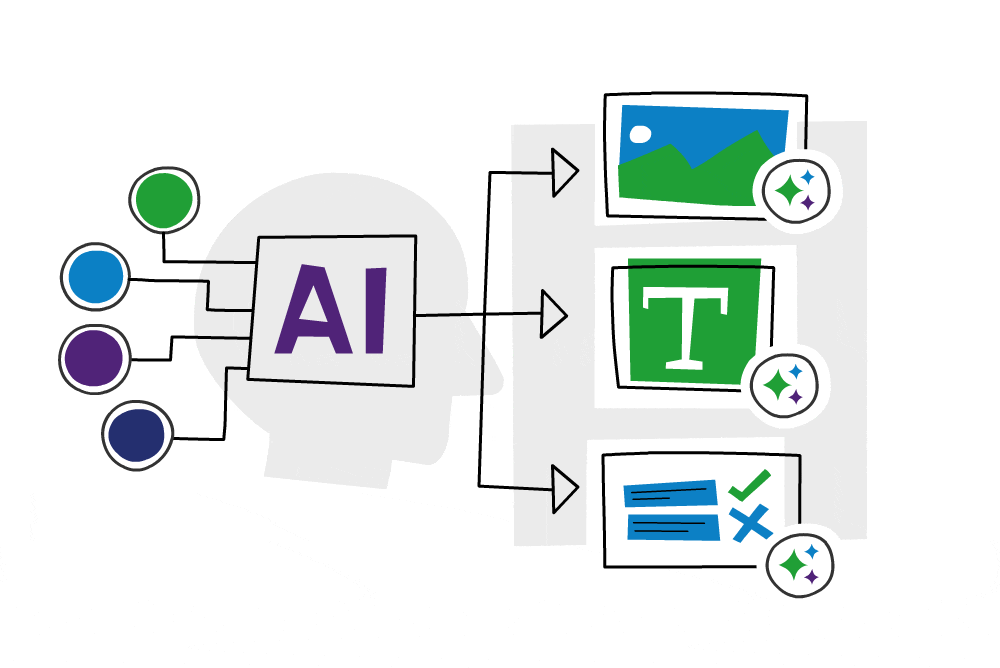
Artificial intelligence is no longer a future consideration in learning and development. AI in eLearning development is now embedded directly into mainstream authoring platforms, including Articulate 360. For eLearning designers working in Articulate Storyline and Articulate Rise 360, AI has moved from experimentation to workflow integration.
At the same time, it’s important to acknowledge governance realities. Some organisations, particularly in regulated or government environments, do not permit the use of AI tools within their development processes. Before adopting any AI strategy, eLearning designers must confirm approval and understand relevant data or privacy policies. Responsible implementation should always come first.
For many professionals, the real question is not whether AI belongs in eLearning development, but how to use it properly. Quality, compliance accuracy, and learner trust remain non-negotiable. AI should enhance professional standards, not dilute them.
Used thoughtfully, AI in eLearning development is not about automation. It is about improving workflow efficiency so designers can focus on higher-value strategic thinking.
Below are ten practical ways eLearning designers can integrate AI into their development process responsibly and effectively.
1. Accelerating Early-Stage Content Structuring
One of the most time-intensive stages of eLearning development is structuring large volumes of raw source material.
Whether working with policy documentation, legislative content or SME interviews, designers spend considerable effort distilling information into learning modules.
AI can assist by generating draft frameworks aligned to key themes. While refinement and analysis remain the designer’s responsibility, AI significantly reduces the initial cognitive load.
This is where AI in eLearning development provides immediate value: it shortens the path from raw content to structured learning architecture.
2. Converting Technical SME Language into Learner-Centred Content
Subject matter experts communicate in technical depth. Learners require clarity.
AI can support eLearning designers by producing learner-friendly draft versions of technical material. Designers then refine the language, tone, and emphasis to ensure it aligns with learning objectives and audience needs.
AI for eLearning designers works best at the drafting stage. It does not replace contextual understanding.
3. Drafting Knowledge Checks Efficiently
Creating robust knowledge checks is essential in eLearning development, particularly in compliance modules.
AI can generate aligned draft questions based on defined learning objectives. Designers must verify factual accuracy and suitability, especially in regulated industries. However, the drafting process becomes significantly more efficient.
AI in eLearning development reduces repetition while maintaining instructional control.
4. Supporting Scenario Development
Scenario-based learning remains one of the most effective methods for encouraging behavioural change.
AI can assist by drafting foundational scenario narratives, including character context and possible decisions. Designers refine these outputs to ensure authenticity, realism and cultural alignment.
When used appropriately, AI strengthens creative momentum rather than replacing it.
5. Refining Tone Across Different Stakeholders
eLearning development often requires tonal adjustments across audience groups.
AI can assist in rewriting content for a more conversational, executive or directive tone without altering the core message. This is particularly useful during stakeholder reviews when feedback requests revisions after initial drafts.
AI enhances adaptability within the eLearning design process.
6. Improving Accessibility Workflows
Accessibility compliance remains central to professional eLearning development.
AI integrated within Articulate Rise 360 can generate initial alt text drafts for images. Designers then validate and refine descriptions to ensure context and accuracy.
This approach maintains accessibility standards while improving production efficiency.
7. Preparing Content for Localisation
Global organisations require scalable eLearning development workflows.
AI can assist in simplifying sentence structures before localisation, reducing ambiguity during translation. It does not replace human translators; rather, it supports cleaner source material and reduces revision cycles.
For multinational organisations, AI in eLearning development adds measurable operational value.
8. Repurposing Existing Learning Assets
Updating existing eLearning content is a common requirement.
AI can summarise longer modules into microlearning refreshers or reinforcement materials. Designers apply updated instructional strategy while leveraging prior content more efficiently.
This use of AI supports sustainable content lifecycle management.
9. Improving Review and Iteration Cycles
Iteration is inevitable within professional eLearning development.
AI can assist in producing alternative versions of sections when stakeholders request restructuring or condensation. Designers maintain final authority, but drafting time reduces significantly.
AI strengthens responsiveness within the design cycle.
10. Refocusing Designers on High-Value Strategy
Perhaps the most meaningful impact of AI in eLearning development is cumulative.
When drafting, restructuring and minor revisions require less manual effort, designers reclaim time for:
- Instructional analysis
- Behavioural mapping
- Interaction design
- Stakeholder consultation
- Evaluation strategy
AI does not diminish professional expertise. It allows that expertise to focus where it matters most.
Maintaining Professional Accountability
Despite its strengths, AI should never be treated as an authoritative content source.
Factual verification, regulatory interpretation, and contextual alignment remain the responsibility of the eLearning designer. AI outputs must always be reviewed, validated, and refined.
Professional standards do not lower in an AI-enabled workflow. In many cases, they become stronger.
AI in eLearning Development Is a Capability Shift
The integration of AI within Articulate 360 signals a broader evolution in how digital learning is produced.
The designers who will lead this shift are those who adopt AI thoughtfully, ensuring it complements rather than replaces instructional expertise.
AI is not about producing more content. It is about producing high-quality eLearning more efficiently, responsibly, and strategically.
Building Confidence in AI-Enabled eLearning
For eLearning designers ready to move beyond experimentation, structured training makes a significant difference.
Our Certified Articulate 360 AI Workshop focuses specifically on applying AI in eLearning development within Storyline and Rise. The workshop covers:
- Responsible AI implementation
- Effective prompting techniques
- Workflow optimisation
- Maintaining compliance standards
- Practical application in real authoring environments
As organisational expectations around AI literacy increase, capability in AI-supported eLearning development becomes a competitive advantage.
Places are limited, and demand continues to grow. If you are ready to integrate AI into your eLearning development workflow confidently and professionally, we invite you to explore the workshop and secure your place.